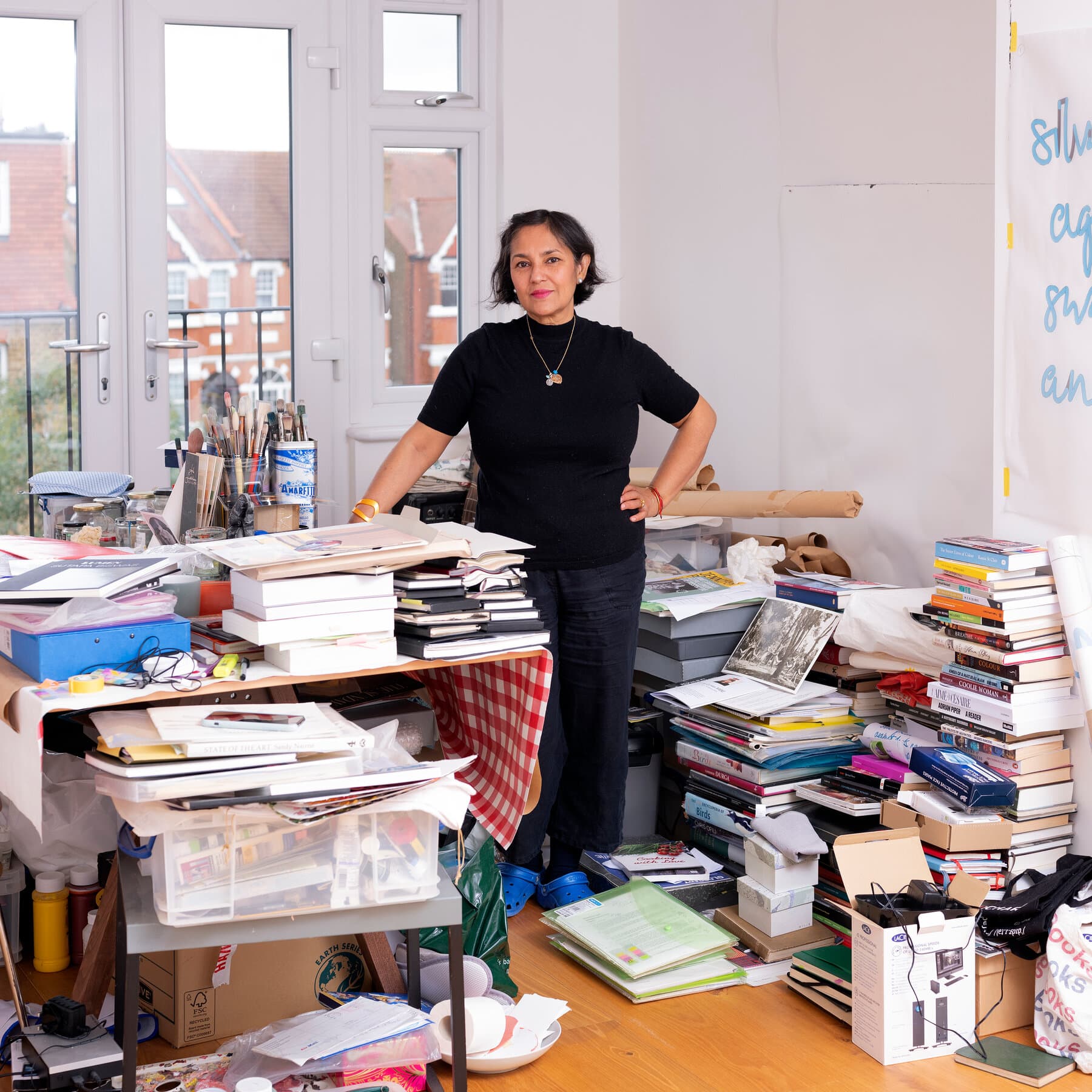
Kalpesh Lathigra for The New York Times
About
Artist, filmmaker, and visual storyteller
Biography
Sutapa Biswas is a British Indian conceptual artist whose practice explores the complexities of racial and gendered power relations born from tangled colonial histories. Spanning painting, film, photography, installation and performance, Biswas has developed a pioneering, poetic and distinctive visual language that moves between histories, time and space. Born in Santiniketan and educated predominantly in the UK, for more than four decades Biswas has created powerful and thought-provoking works that challenge dominant historical narratives, examining the enduring legacies of colonialism through questions of race, gender, migration and representation. Her unapologetic work brings overlooked histories and personal narratives to the fore, revealing how the legacies of empire continue to shape life and structures of power today.
Sutapa Biswas commented, "My works are 'spatial stories' shaped by observations about the relationship between my subjects and the places they live, often focusing on the entangled histories of colonialism with undocumented personal narratives. To me, it’s like finding loose threads that unravel and ravel, and my work re-configures these. Through introducing poetic elements, I hope my works create a space for a dialogue with the viewer”.
Biswas graduated with a BA in Fine Art with Art History from the University of Leeds in 1985 and completed a postgraduate degree at the Slade School of Fine Art in 1990. She subsequently undertook research at the Royal College of Art. A key figure in the emergence of the Black Arts Movement in Britain during the 1980s, Biswas’s works were selected immediately following her graduation in 1985, for the landmark exhibition The Thin Black Line curated by Lubaina Himid, hosted at the ICA, London, wherein Biswas showed her monumental painting Housewives with Steak-knives, 1983-85 (Collection Cartwright Hall, Museums Bradford, UK), and her iconic video Kali, 1983-85 (TATE Collection). In the recent 2025 re-iteration of this landmark show at the ICA curated by Himid 40 years on, Biswas exhibited more recent works including her poetically hypnotic film installation Birdsong, 2004 (16mm film re-telecined onto 4K, 2021) featuring her son, which was highlighted in Frieze magazine’s review. Her works Housewives with Steak-knives, 1983-85 and Kali 1983-85 were also included in Women in Revolt! Art and Activism in the UK 1970–1990 at Tate Britain in 2023-2024, and Housewives with Steak-knives features as the cover image to Tate’s A Brief History of British South Asian Art by Alina Khakoo published in 2025, and is included in Charlotte Mullins's book A Little Feminist History of Art, published by Tate, 2025.
Sutapa Biswas’ works have been internationally exhibited and widely reviewed. In 2021-2022, Biswas held two satellite major solo exhibitions Lumen: Sutapa Biswas at Kettle’s Yard, Cambridge University, and BALTIC, Gateshead which were widely reviewed including in The New York Times and the Financial Times. A monograph accompanying these solo shows including essays by Dr. Courtney J. Martin, Griselda Pollock, and Anna Arabindan-Kesson, is published by Kettle’s Yard, BALTIC and Riding House Books. In 2022, Biswas’s film Lumen, 2021, was debuted for its USA screening at the Yale Center for British Art. Other venues that have hosted her works include TATE (UK), YBA & Beyond: British Art in the 1990s from Tate’s Collection, 2026 (Japan), Yale University Art Gallery (New Haven), Tantra: enlightenment to revolution, The British Museum, Yale University Art Gallery, ‘Mixed Bathing World 2015’ Triennial (Oita, Japan), 6th Havana Biennial, Neuberger Museum (New York), Art Gallery of Ontario (Toronto), Melbourne International Arts Festival, Whitechapel Gallery (London), Arnolfini (Bristol) and SF Camerawork (San Francisco). Previous solo shows of Biswas's works have also been hosted by Autograph abp, (UK), Nara Roesler (Brazil), Iniva (UK), Douglas Cooley Gallery (Reed College, USA), PlugIn Institute of Contemporary Art (Canada) with Locus+ (Newcastle Upon Tyne, UK), Or Gallery (Vancouver, Canada), OBORO (Montreal, Canada) Leeds City Art Gallery and The Photographer’s Gallery (UK).
Sutapa Biswas lives and works in London, England.
PUBLIC COLLECTIONS
Biswas's works are held in both private and public collections. Public collections hosting Biswas's works include TATE, the Government Art Collection (UK), Arts Council England, Reed College Gallery (USA), Sheffield Museums and Galleries (UK), Cartwright Hall Bradford Museums and Art Galleries (UK), Oldham Gallery (UK), Rochdale Art Gallery (UK), Stanley and Audrey Burton Gallery, University of Leeds (UK), Bristol Museums and Art Gallery (UK), and the National Gallery of Botswana.
SELECTED HONOURS AND AWARDS
Sutapa Biswas is a Fellow of Yale University and recipient of the Yale Center for British Art Visiting Scholars Award 2019-20, East Gallery Fellow, Norwich University of the Arts, and a twice Fellow, Banff Center for The Arts, Alberta, Canada. Inspiring generations of artists and scholars whom Biswas has previously taught and mentored, many of whom have since become internationally recognised figures including the artists Zineb Sedira, Hew Locke, Haroon Mirza, Jonathan Baldock and Harold Offeh, in recognition of her extensive work and important contribution to the field of fine art and art history, in 2026 Sutapa Biswas was appointed Honouree and Fellow, Association for Art History (FAAH) and an Honorary Professor, Norwich University of the Arts. Biswas was the recipient of the 2019 ArtUK Fund Award, made to support the realisation of her hauntingly powerful film Lumen, 2021 produced in collaboration with Film and Video Umbrella, UK and Bristol Museums and Art Gallery. She was the Andrew W. Mellon Fellow at the Yale Centre for British Art (2008), a Visiting Artist at Mills College and Stanford University (1994), a recipient of the Correnah W.Wright Endowment Fund and The National Endowment for the Arts Award (1994), and is a European Photography Award Nominee, 1992.
FURTHER INFORMATION ABOUT SUTAPA BISWAS
Sutapa Biswas is one of a handful of artists who through her artistic, scholarly and academic work since the early 1980s has led the decolonisation of fine art practices and critical theories of art history. Now entirely dedicated to her studio practice, for forty years between 1985 to 2025 alongside making and exhibiting her art internationally, Sutapa taught fine art and art history from undergraduate to postgraduate levels within higher education institutions and art school contexts in the UK, including at Central Saint Martin’s College of Art, UAL (13 years), Chelsea College of Art and Design, UAL (where she was a Reader and taught for over 23), Winchester School of Art, Southampton University (7 years), and at Manchester School of Art, MMU (as a Reader of Fine Art, 9 years). Beginning from her time as an undergraduate student in Fine Art with Art History at the University of Leeds, in a department established by the social art historian T.J. Clark, wherein as her former tutor the feminist art historian Griselda Pollock published the following, “Biswas in the context of a specific department and one of a few in a British university that brought the practice of fine art within its regimes of academic study, wherein “art history – predominantly grounded in historical materialism – insured that theoretical revision proceeded from an understanding of interests, power, domination, exploitation. […] Feminism played a vital part in the historical and political discourses, that were developing at Leeds. […] The critique and critical revisions of modernist art and art history, which feminism necessitates, were fast becoming the hallmark of the Leeds Department of Fine Art. There can be no doubt that this academic environment, this conversational community, influenced Sutapa Biswas. But…Biswas’s presence on the course was also highly influential. It was she who defined the absences in these seemingly radical discourses deriving from Marxism and feminism. It was she who named the imperialism that still structured analyses., and which spoke in undifferentiated terms of class and gender, never acknowledged the issues of race and colonialism. It was her critique that forced us to all acknowledge the Eurocentric limits of the discourses within which we practised. Her challenge was mounted face to face, not at the level of abstract taunts, but by direct engagement in dialogue of people sharing a space, a space thus assumed by her generosity to be able and willing to enlarge the critical discourse to accommodate the subjects of class, gender and race in their intricate and painful configurations between us and within us. She demanded change; and response was made, and the course altered. With the question of imperialism and its racist practices no longer repressed, the space of the studio and the lecture theatre had to be made to articulate the pressure of the social and psychic relations that imperialism, as a still-powerful structure, installed in us all. Instead of presenting binary oppositions, Sutapa Biswas’s practice as a student and producer of artworks systematically eroded the cliché of accusation and hence did not induce defensive withdrawal stemming from guilt.” [Griselda Pollock, Tracing the Figures of Presence: Naming Ciphers of Absence. Feminism, Imperialism and Postmodernity: The Work of Sutapa Biswas. Published by Iniva (UK) and Reed College (USA), 2004. To read Griselda Pollock's essay, please see: https://sutapabiswas.com/published-essays.]
Of Biswas's works, the author and Director of Whitechapel Gallery, Gilane Tawadros writes, "Looking across more than two decades of her distinctive artistic practice, there is one continuous and recurring subject matter that emerges forcefully from Sutapa Biswas’s work: time. Not linear time that moves sequentially from beginning to end. Nor present time, unhinged from the past. Time, in Biswas’s work, is fleeting and elusive and yet capable of changing everything irrevocably, over and over again. The fragile, metallic birds in her ...film, Magnesium Bird, [2004] are ignited and metamorphose before our eyes, almost beyond recognition. The small boy who sits waiting, staring expectantly out towards the camera in Birdsong, [2004], awaits a magical happening that transforms his immediate, everyday world. In these works, Biswas’s lens captures a quality of time and light that finds echoes in the great paintings of Vermeer, Stubbs and Hopper.
From her earliest paintings of the 1980s through to her more recent film works, Biswas has been preoccupied with the search to push representation beyond the secure confines of describing the physical world to embody the pleasure and pain of lived experience. [Through her art] Biswas takes this search further to produce poetic works that are magical and compelling.” [Excerpt From Sutapa Biswas: Birdsong. Monograph. Published by Iniva, London, and Douglas F. Cooley Memorial Art Gallery, 2004, to coincide with the exhibition Sutapa Biswas: Birdsong, Café Gallery Projects, London; Angel Row Gallery, Nottingham; Harewood House and Leeds City Art Gallery, Leeds; and Douglas F. Cooley Memorial Art Gallery, Portland, Oregon, 2004-2005.]
DACS: COPYRIGHT AND IMAGE LICENSING ENQUIRIES
Sutapa Biswas's works are represented by DACS. For licensing enquiries and permissions, please contact DACS.
CV
BIOGRAPHY
- Born 1962, in Santinikethan, India
- Lives and works in London, UK
EDUCATION
- 1995-1998Research Student, Department of Painting, Royal College of Art, 1995-98
- 1990Fellow of Photography, The Banff Centre for the Arts, Banff, Alberta, Canada
- 1988-1990Postgraduate Higher Diploma in Fine Art, Slade School of Fine Art, UCL, London University
- 1981-1985B.A. Honours in Fine Art with Art History, with Year 1 (1981-82) subject option in History and Philosophy of Science, University of Leeds
Studio WEBSITE
- Sutapa Biswas sutapabiswas.com (opens in new tab)
Former Academic TEACHING POSITIONS
- 2016-2025Reader in Fine Art, Manchester School of Art and Performance, MMU
- 2006-2012Reader in Fine Art and Cultural Studies, Chelsea College of Art & Design, UAL
- 2004-2006Senior Lecturer, Chelsea College of Art & Design, UAL
- 1989-2004Lecturer, Chelsea College of Art & Design, UAL
HONOURS, AWARDS AND FELLOWSHIPS
- 2026Honorary Professor, Norwich University of the Arts, UK
- 2026Honouree and Fellow, Association for Art History forarthistory.org.uk (opens in new tab)
- 2024East Gallery Fellow, Norwich University of the Arts, UK
- 2020Paul Mellon Centre, Publication Grant, towards a long-form monograph focussing on the work of Sutapa Biswas. Art Fund 2020 Award, UK. In support of the production of my film Lumen, 2021, in collaboration with Film and Video Umbrella, London, Bristol Museum and supported by the Moving Image Fund for Museums. Made possible thanks to Thomas Dane Gallery and a group of private galleries and individuals. Nominator, Museum of Art and Design Artists Residency, New York, USA (2018-2020)
- 2019-2020Fellow, Yale Center for British Art Visiting Scholars Award, Yale University
- 2018Nominee, Freelands Award 2018.
- 2009Visiting Artist and Andrew W. Mellon Fellow, Yale Center for British Art, Yale University
- 2008LAFVA 2008 Award (London Artists Film and Video Award), UK. Member of Board of Directors, Film and Video Umbrella, UK (2008-2013)
- 2005New commission for permanent site-specific artwork, New Art Exchange, Nottingham. Realised in collaboration with Hawkins/Brown with support from ACE.
- 2004Arts Council England Grants for National Touring in collaboration with inIVA (Institute of International Visual Arts), London, UK
- 2002Recipient, Arts and Humanities Research Board, UK
- 2002Member of Senate, University of Southampton, UK
- 1998Visiting Artist and Fellow, Calhoun College, Yale University, New Haven, USA
- 1997Visiting Artist, Visiting Artists Series, Stanford University. One of six internationally based artists selected as part of this prestigious annual series.
- 1997Artist representing Britain, Havana Biennial, Cuba.
- 1996Member of Board of Directors, Institute of International Visual Arts (Iniva), London, UK (1996-98)
- 1994Recipient, Correnah W.Wright Endowment Fund and The National Endowment for the Arts Award, Visiting Artist, Mills College, California, USA
- 1993New Commission, The Western Front, Vancouver, Canada Artist’s Project Development Award, London Arts Board, UK
- 1992Nominee, European Photography Award sponsored by Deutsche Leasing
- 1992Member of the Board of Advisors, Visual Arts, Arts Council of England (1990-1992)
- 1992Fellow, The Banff Centre for the Arts, Banff, Alberta, Canada
- 1992Recipient, Charlotte Townsend Award, Canada
- 1991Project Development Award, Arts Council of Great Britain
- 1990Fellow of Photography, The Banff Center for The Arts, Banff, Alberta, Canada
- 1990Recipient, The Mark Turner Award, Canada
PUBLIC ART COLLECTIONS
- UK TATE Collections tate.org.uk (opens in new tab) tate.org.uk (opens in new tab)
- Government Art Collection
- Bristol Museums
- Sheffield Museums and Art Galleries
- Cartwright Hall, Museums Bradford
- Oldham Museums
- Rochdale Art Gallery
- The Stanley and Audrey Burton Gallery, Leeds University
- Arts Council England
- Reed College, The Douglas Cooley Memorial Art Gallery, US
FORTHCOMING AND RECENT EXHIBITIONS
- 2028-2029Sutapa Biswas, solo show, Pitzhanger Manor & Gallery, London
- 2026-2027Sutapa Biswas, Solo show and Collaboration with Government Art Collection and East Gallery, Norwich University of the Arts, UK
- 2027Sutapa Biswas, solo exhibition, Stanley & Audrey Burton Gallery, University of Leeds, UK
- 2026Sutapa Biswas, Kali (1983-85), Tate Britain, Permanent Display Galleries (2025-2026)
- 2026Sutapa Biswas in YBA and Beyond, Tate Touring hosted by the National Center for Art, Tokyo, and KyotoCity Kyocera Museum of Art, Japan (2026). Group exhibition. Exhibition catalogue / book: ISBN: 978-4-87929-999-4
- 2025Sutapa Biswas, in ICA Cinema Screening - Sutapa Biswas: Kali & Lumen + Q & A with art historian Griselda Pollock and curator, Jasmine Chohan. Wednesday 9 July, 2025. Programme: Connecting Thin Black Lines ica.art (opens in new tab)
- 2025Sutapa Biswas in Connecting Thin Black Lines, Institute of Contemporary Art, London, UK. Group exhibition curated by Lubaina Himid and Nicola Leong. Group exhibition: theguardian.com (opens in new tab)
- 2024 – 2025Sutapa Biswas, in Photographing the 1980s, Tate Britain: 21 November 2024 - 5 May 2025. Group exhibition
- 2023-2025Sutapa Biswas, To Touch Stone, Tate Britain, Gallery 26. Part of Tate Britain's gallery rehang of its collections: tate.org.uk (opens in new tab)
- 2023-2025Sutapa Biswas, in Women in Revolt! Art and Activism in Britain 1970 to 1990. Tate touring - Tate Britain; Scottish National Galleries, Modern Art 2; Whitworth Gallery, Manchester (7 March - 1 June 2025). Group exhibition: tate.org.uk (opens in new tab)
- 2024-2025Sutapa Biswas, in Sit-In #4: Outside the Circle, Cooper Gallery, Duncan of Jordanstone College of Art & Design, University of Dundee, Scotland. Group Exhibition
- 2024Sutapa Biswas, in Photographing Ecospheres, Joburg Contemporary Art Foundation, Johannesburg, South Africa. Group exhibition
- 2023Sutapa Biswas, in Medium & Memory, curated by Griselda Pollock, HackleBury Fine Art, London
- 2023Sutapa Biswas, New commission for Hospital Rooms, Hauser & Wirth, London SOLO EXHIBITIONS and PROJECTS
- 2022-2023Sutapa Biswas, Newlyn & Exchange art galleries, Cornwall
- 2022-2023Sutapa Biswas, Lumen, New Art Gallery, Walsall, UK
- 2021-2022Sutapa Biswas: Lumen, Newlyn Art Gallery and The Exchange, Cornwall, UK Kettle’s Yard, Cambridge University, UK. kettlesyard.co.uk (opens in new tab) nytimes.com (opens in new tab) ft.com (opens in new tab)
- 2021-2022Sutapa Biswas, in Lumen: Sutapa Biswas, BALTIC Centre for Contemporary Art, Gateshead, UK. archive.baltic.art (opens in new tab) [Accessed 6 April 2026]
- 2022Arnolfini, Bristol, UK
- 2022Autograph, London, UK
- 2022Hospital Rooms, Springfield NHS Hospital, London. New commission. For more information, please see Alex Marshall’s NYT review: Bringing World-Class Art and Wonder, to Mental Health Patients nytimes.com (opens in new tab)
ARTIST IN RESIDENCE
- 2019Artist in Residence, Tainain, Taiwan. Part of the city-wide exhibition 'Next Art Tainain' curated by Dr. Ming Turner.
- 2015Kashima Artist in Residence, Beppu, Oita, Japan. In collaboration with Beppu Project and the Agency for Cultural Affairs, Government of Japan.
- 2014-2015Artist in Residence, Tate Britain as part of ‘RadioCity 2014/15’ in collaboration with Resonance Radio, London.
- 2006Portland Institute of Contemporary Art (PICA) Time Based Arts (TBA) Festival
- 2006, Portland, Oregon, USA.
- 2000Artist in Residence & Curator of the exhibition Private Thoughts / Public Moments, the Historical Galleries, Art Gallery of Ontario, Toronto, Canada.
- 1995Artist in Residence, Thapong International Workshop, Mahalapye, Botswana.
- 1994Artist in Residence, at Plug-In Art Gallery (Winnipeg, Canada). This entailed a commission to produce a new artwork which was supported by the UK based arts organisation Locus + (Newcastle Upon Tyne).
- 1990-1991Artist in Residence & Curator of the exhibition Memory and Desire, Vancouver Art Gallery, Canada.
- 1988Whitechapel Art Gallery, London, UK.
- 1986City Museum and Art Gallery, Stoke-on-Trent, UK. Curated by Emma Dexter
PREVIOUS SOLO AND TWO-PERSON EXHIBITIONS / PROJECTS
- 2019Two Person exhibition, 182 Gallery, Next Art Tainan, Taiwan. A citywide exhibitions project curated by Dr. Ming Turner. Generously supported by the Taiwan Government.
- 2017-2018‘a hundred songs for Kneeze and Vijay’ a new site-specific neon artwork and commission by the organisation PORe (UK). Venue: Rochdale Interchange. Realised with the generous support of Arts Council England.
- 2008Nara Roesler gallery, Sao Paulo, Brazil. Part of the Roesler Hotel, a project annually year inviting artists of international standing to exhibit works.
- 2006SUTAPA BISWAS, Recent Works, Douglas F. Cooley Memorial Art Gallery, Reed College, Portland, Oregon, USA (touring exhibition). Magnesium Dreams, TBA:2006, Portland Oregon, USA. Performance work commissioned by TBA: 2006 Sutapa Biswas, Elizabeth Leach Gallery, Portland, Oregon, USA
- 2004SUTAPA BISWAS, Recent Works, by Sutapa Biswas, Café Gallery Projects (London), Angel Row Gallery, Nottingham; Leeds City Art Gallery, Leeds SUTAPA BISWAS, Recent works by Sutapa Biswas, and drawings by Joseph Turner and Edward Lear, Harewood House, Yorkshire, UK
- 2000Sutapa Biswas, Untitled (woman in blue, weeping), 1996, Art Gallery of Ontario, Toronto, Canada
- 1994Murmur, Atlas Studio Space, London Synapse / To Kill Two Birds with One Stone, Plug-In Gallery, Winnipeg, Canada. This new commission was supported by the UK based arts organisation Locus + (Newcastle Upon Tyne) and the Plug-In Gallery, Winnipeg (now renamed as the Plug In, Institute of Contemporary Art) and involved producing a major new installation + performance work. With generous support from the British Council Murmur, The Western Front, Vancouver, Canada
- 1993Synapse, Sutapa Biswas, Gallerie OBORO, Montreal, Canada
- 1992Synapse, The Photographer’s Gallery, London, and City Art Gallery, Leeds, UK Synapse, Or Gallery, Vancouver, Canada
- 1987Sutapa Biswas, Horizon Art Gallery, London
- 1986Sutapa Biswas, Stoke City Museum and Art Gallery
SELECTED GROUP EXHIBITIONS
- 2026Sutapa Biswas in YBA and Beyond, Tate Touring hosted by the National Center for Art, Tokyo, and KyotoCity Kyocera Museum of Art, Japan (2026). Group exhibition
- 2025Sutapa Biswas in Connecting Thin Black Lines, Institute of Contemporary Art, London, UK. Group exhibition curated by Lubaina Himid and Nicola Leong. Group exhibition: theguardian.com (opens in new tab)
- 2024 – 2025Sutapa Biswas, in Photographing the 1980s, Tate Britain: 21 November 2024 - 5 May 2025. Group exhibition
- 2024Sutapa Biswas, in Time of Our Lives, Drawing Room, London
- 2023-2025Sutapa Biswas, in Women in Revolt! Art and Activism in Britain 1970 to 1990. Tate touring - Tate Britain; Scottish National Galleries, Modern Art 2; Whitworth Gallery, Manchester (7 March - 1 June 2025). Group exhibition: tate.org.uk (opens in new tab)
- 2024-2025Sutapa Biswas, in Sit-In #4: Outside the Circle, Cooper Gallery, Duncan of Jordanstone College of Art & Design, University of Dundee, Scotland. Group Exhibition
- 2024Sutapa Biswas, in Photographing Ecospheres, Joburg Contemporary Art Foundation, Johannesburg, South Africa. Group exhibition
- 2023Sutapa Biswas, in Permanent Display (re-hang 2023), Tate Britain tate.org.uk (opens in new tab)
- 2023Sutapa Biswas, in A Tall Order!, Rochdale Art Gallery: artmonthly.co.uk (opens in new tab)
- 2020-2021Tantra: From Enlightenment to Revolution, The British Museum. Curated by Dr. Imma Ramos. theguardian.com (opens in new tab) ft.com (opens in new tab) thequietus.com (opens in new tab) openthemagazine.com (opens in new tab)
- 2020Sutapa Biswas, in Midnight’s Children: 70 Years of Indian Artists in Britain, Ben Uri Gallery. Online exhibition
- 2019Sutapa Biswas, in Lessons In the Studio: Studio in the Seminar. The past 70 years of Fine Art at the University of Leeds, through artworks, artifacts, and multimedia. Curated by Griselda Pollock and Sam Belifante.
- 2018-2019Sutapa Biswas, in Speech Acts, Manchester Art Gallery. Curated by Hammad Nasar with Kate Jesson
- 2017Sutapa Biswas, in A Feminist Space in Leeds, University of Leeds Project Space. Curated by Gill Parks. fine-art.leeds.ac.uk (opens in new tab) Sutapa Biswas, in Notes From Another India: Sutapa Biswas & Pratibha Parmar, 26 September 2017, Hyde Park Picture House. Including a screening of Sutapa Biswas’ moving image work Kali, 2004 (Tate Collection). Followed by in-conversation Sutapa and Griselda Pollock. pavilion.org.uk (opens in new tab)
- 2017Sutapa Biswas, ‘In Perpetuity’ - a site-specific mural work at the NHS Garnet Ward, The Whittington Hospital, London, UK. Commissioned by the arts organisation Hospital Rooms, UK. Realised with the generous support of Arts Council England and Daler. The Place is Here, Nottingham Contemporary. Group exhibition. nottinghamcontemporary.org (opens in new tab)
- 2016Liberties, an exhibition of contemporary art reflecting on 40 years since the Sex Discrimination Act (1975), Newlyn Art Gallery, UK
- 2015Artist, ‘Mixed Bathing World 2015’, Beppu Triennial, Japan
- 2015Artist in Residence, Beppu Project, Japan (late June / July 2015)
- 2014-2015Artist in Residence, Tate Britain, UK. ‘Flights of Passage’- a sound, installation, performance work for ‘Tate RadioCity’ in collaboration with Resonance 104.4FM
- 2015Liberties, an exhibition of contemporary art reflecting on 40 years since the Sex Discrimination Act (1975), Collyer Bristow Gallery, London, UK. Group exhibition
- 2015‘Feathered’, Touchstones, Rochdale, UK. Group exhibition (details to be confirmed)
- 2014Tate Liverpool: Keywords: Art, Culture and Society in 1980s Britain, curated by Tate Liverpool in collaboration with Grant Watson (Iniva, UK). Group exhibition
- 2012Sutapa Biswas, in Tate Britain: Thin Black Line(s). Curated by Lubaina Himid and Paul Goodwin. Exhibiting artists: Sutapa Biswas, Veronica Ryan, Lubaina Himid, Sonia Boyce, Maud Sulter, Ingrid Pollard, Claudette Johnson
- 2012Sutapa Biswas, in Art Now: Identity in Contemporary Art – Permanent Collections display, Graves Gallery, Museums Sheffield, Sheffield. Acquisition made possible with generous support from the Contemporary Art Society, UK
- 2011Sutapa Biswas, In Perpetuity, New Commission and site-specific work, New Art Exchange with Arts Council England. Realized in collaboration with Hawkins Brown.
- 2010Sutapa Biswas, in Twenty-One: Celebrating 21 years of Art at the Terrace Gallery and 200 years of art at Harewood House, Yorkshire, UK. Exhibiting artists included: Sutapa Biswas, David Hockney; Ian McKeever; Sonia Boyce; Mark Wallinger; Paul Rooney
- 2010Sutapa Biswas, in A Missing History: The Other Story - Revisited, Aicon Gallery London. Group exhibition curated by Niru Ratnam. Exhibiting artists included: Sutapa Biswas, Rasheed Araeen, David Medalla, Aubrey Williams, FN Souza, Shemza, Lubaina Himid, Sonia Boyce
- 2010Sutapa Biswas, in PINTA London, UK. Nara Roesler Gallery, Sao Paulo, Brazil
- 2009Sutapa Biswas, in British Subjects: Identity and Self-fashioning 1967-2009, Neuberger Museum, Purchase College, State University of New York, USA (September - December). Curated by Louise Yelin 3a.ro (opens in new tab)
- 2009Sutapa Biswas, in Lo Real Maravillosa / Marvellous Reality. Curated by Gallery Espace in New Delhi. This was a landmark group exhibition realized in collaboration with the Lalit Kala Akademi, New Delhi, India
- 2008Sutapa Biswas, PINTA New York, USA - represented by Nara Roesler, Sao Paulo, Brazil
- 2006Sutapa Biswas, Portland Institute of Contemporary Art (PICA) Time Based Arts (TBA) Festival 2006, Portland, Oregon, USA
- 2006Sutapa Biswas, Melbourne International Arts Festival 2006, Australia
- 2006Sutapa Biswas, Aqua Miami, Miami Basel, USA - represented by Elizabeth Leach Gallery, USA
- 2006Sutapa Biswas, Migratory Aesthetics, The University of Leeds, Parkinson Gallery, Leeds. Curated by Griselda Pollock and Judith Tucker. Exhibiting artists included: Sutapa Biswas, Isaac Julien, Lubaina Himid
- 20053rd Clerkenwell Film and Video Festival, London. Curated by Mahony, Emma (Hayward Gallery, London). Sutapa Biswas, exhibiting Magnesium Bird (2004). Other exhibiting artists: Phil Collins; Doug Fishbone; Seamus Harahan
- 2005Sutapa Biswas, Royal Academy of Arts, London. Launch of Contemporary Patrons Group. Group exhibition March 17, 2005. Other exhibiting artists included: Pipilotti Rist, Rose Finn-Kelcey, Tracey Emin, Tony Ousler, Christian Marclay
- 2002-2003From Tarzan to Rambo, Tate Modern, London, UK. Sutapa Biswas, exhibiting: Untitled (The Trials and Tribulations of Mickey Baker). Other exhibiting artists: Sonia Boyce, Zoe Leonard, Harold Offeh
- 2001Art Through the Eye of A Needle, Henie Onstad Kunstsenter, Oslo, Norway. Curated by Selene Wendt. Sutapa Biswas, exhibiting: To Kill Two Birds with One Stone. Other exhibiting artists included: Yinka Shonibare, Ghada Amer, Lisa Lui
- 1999Sutapa Biswas, Crown Jewels, Kampnagel, Hamburg, Germany. Group exhibition realised with the generous support of the British Council
- 1998The Unmapped Body: 3 Black British Artists – Sutapa Biswas, Sonia Boyce and Keith Piper, Yale University Art Gallery, New Haven, USA. Curated by Daphne Deeds and Ian Baucom. The first exhibition of works by contemporary artists hosted at this venue.
- 1997Sutapa Biswas, Admissions of Identity, Sheffield Museums and Mappin Art Gallery, Sheffield, UK
- 1997Sutapa Biswas, 6th Havana Biennial / Sexta Bienal de La Habana – el individuo y su memoria, mayo, junio, Havana, Cuba
- 1997Sutapa Biswas, Krishna The Devine Lover, curated by Balraj Khanna, Whitechapel Art Gallery, London. Sutapa Biswas, exhibiting: Untitled (The Trials and Tribulations of Mickey Baker), 1997
- 1997Sutapa Biswas, Transforming the Crown, 1966-1996, Franklin H. Williams Cultural Centre, Brooklyn Museum, New York, USA. Group show, and touring exhibition, USA
- 1997Sutapa Biswas, in Cross-Currents / Krysinger, University of Ethnography, Oslo, Norway. With generous support from the British Council. Group show and touring exhibition
- 1997Sutapa Biswas, MAPPA, Amos Anderson Gallery, Helsinki, Finland. With support from the British Council
- 1996Sutapa Biswas, in The Visible and the Invisible: representing the body in contemporary art and society. Curated by Tom Trevor and Zoe Shearman, in collaboration with inIVA, London, UK. Group Exhibition hosted across 5 sites in the London: St. Pancras Church, Euston Station, Welcome Trust, University College, London, and Marylebone Road, London. Sutapa Biswas, exhibiting: Untitled (woman in blue weeping) - new commission by Iniva. Other exhibiting artists included: Vito Acconci, Louise Bourgouise, Bruce Nauman, Yoko Ono, Doris Salcedo, Donald Rodney, Virginia Nirmakoh
- 1994Sutapa Biswas, in Diver’s Memories, Manchester Museum, Manchester, UK. Group show. Sutapa Biswas exhibiting: Strange view (1996) National Gallery, Botswana.
- 1994Sutapa Biswas, in EXPO ARTE, Feria International De Galerias De Arte Contemporaneo, Guadelahara, Mexico. Group exhibition
- 1994Sutapa Biswas, in Beyond Destination, Ikon Gallery, Birmingham, UK. Sutapa Biswas, exhibiting Murmur (commissioned by Ikon Gallery and The Western Front, Vancouver, Canada)
- 1993-4 Sutapa Biswas, exhibiting Tinker, Tailor, Tailor, Soldier, Sailor, Richman, Poorman, Beggarman… (site-specific installation) Pitt Rivers Museum, Oxford
- 1992Sutapa Biswas, in The European Photography Award, Kunstlerwrkstatt, Berlin, West Germany. Touring exhibition, West Germany
- 1992Sutapa Biswas, in The Body Politic, Herter Art Gallery, University of Massachusetts, USA. Group exhibition. Other exhibiting artists: Ashley Bickerton, Kiki Smith, May Stevens
- 1992Sutapa Biswas, in Who do You Take Me For? Museum of Modern Art, Brisbane, Australia. Touring exhibition, supported by British Council
- 1991Sutapa Biswas, in Memory and Desire, Vancouver Art Gallery, Vancouver, Canada. Curated by Sutapa Biswas. Realised with the generous support of the British Council
- 1991Fabled Territories, Vancouver Art Gallery, Canada. With support from the British Council
- 1991Sutapa Biswas, in The Circular Dance, Arnolfini, Bristol, UK. Sutapa Biswas exhibiting: To Touch Stone (1991)
- 1990Disputed Identities, Camerawork, San Francisco, UK
- 1989Sutapa Biswas, in Images of Woman, Leeds City Art Gallery, UK. Curated by Corinne Miller. Sutapa Biswas - Housewives with Steak-knives (1985). Other exhibiting artists included: Artemesia Gentileschi, Roy Lichenstein, Giovanni Bellini, Richard Hamilton, and Helen Chadwick
- 1989Sutapa Biswas, in Intimate Distance, The Photographer’s Gallery, London, UK. Sutapa Biswas, exhibiting: Infestations of the Aorta-Shrine to A Distant Relative. Exhibiting artists: Sutapa Biswas, Ingrid Pollard, Mona Hatoum, Zarina Bhimji, Maxine Walker
- 1988Sutapa Biswas, in British Artists Abroad, Usher Gallery, Lincoln, UK. Sutapa Biswas exhibiting: Pied Piper of Hamelin - Put Your Money Where Your Mouth is… (1997)
- 1987-8 Sutapa Biswas, in The Essential Black Art, Chisenhale Art Gallery, London, UK. Curated by Rasheed Araeen. Sutapa Biswas exhibiting: Housewives with Steak-knives (1985). Other exhibiting artists included: Mona Hatoum, Keith Piper, Sonia Boyce
- 1988Critical Realism, Camden Arts Centre, London, UK Sutapa Biswas, Pied Piper of Hamelin - Put Your Money Where Your Mouth is in. Touring exhibition. Other exhibiting artists: Susan Hiller, Stuart Brisley, Sue Coe, Ken Currie
- 1986-19871986-7 State of The Art: Ideas and Images in the 1980s, ICA, London, UK. Curated by Sandy Nairne & hosted as an art documentary series in collaboration with Channel 4 TV. Exhibiting artists included: Sutapa Biswas, Sonia Boyce, Lubaina Himid, Susan Hiller, Hans Haacke, Jean-Michel Basquiat, Andy Warhol, Miriam Cahn illuminationsmedia.co.uk (opens in new tab)
- 1986Jagrati, Greenwich Citizens Gallery
- 1986Sutapa Biswas, in Unrecorded Truths, The Elbow Room, London, UK. Curated by Lubaina Himid. Sutapa Biswas exhibiting: Blind man’s Bluff (1986). Other artists included: Donald Rodney, Sonia Boyce, Marlene Smith
- 1986-1987Sutapa Biswas, in The Issue of Painting, Air Gallery, London, UK. Curated by Iwona Blazwick. An exhibition of works by three women artists: Sutapa Biswas, Glenys Johnson and Margaret Harrison. Touring exhibition
- 1985-1986Sutapa Biswas, in Thin Black Line, ICA (Institute of Contemporary Art), London, UK. Curated by Lubaina Himid. Sutapa Biswas exhibiting: Housewives with Steak-knives, and The Only Good Indian… and Her Story. Exhibiting artists included: Sutapa Biswas, Sonia Boyce, Chila Burman, Jennifer Comrie, Lubaina Himid, Claudette Johnson, Veronica Ryan, Marlene Smith, Maud Sulter
PUBLISHED MONOGRAPHS / BOOKS
- 2021SUTAPA BISWAS: LUMEN (in print). Published by Riding House, with Kettle’s Yard, University of Cambridge, and BALTIC Centre for Contemporary Art. With generous support from the Paul Mellon Centre, and the School of Art, MMU. ISBN: 9781909932647 autograph.org.uk (opens in new tab)
- 2004SUTAPA BISWAS, an anthology of essays on the work of the artist Sutapa Biswas. Essays by Griselda Pollock, (Professor of Art History, University of Leeds); Laura Mulvey (Professor of Film and Media Studies at Birbeck College, University of London, and former Director of the AHRB Centre for British Film and Television Studies); Guy Brett (art critic, writer and internationally renowned curator of exhibitions); Moira Roth (Trefethan Professor of Art History, Mills College, USA, and author); Stephanie Synder, (Director and Chief Curator of the Douglas F. Cooley Memorial Art Gallery at Reed College, Portland, Oregon); Ian Baucom (Associate Professor of English at Duke University, and author); Sutapa Biswas (artist and Lecturer). Published by the Institute of International Visual Arts (inIVA), London, and The Douglas F. Cooley Memorial Art Gallery, Reed College, USA, pp 1-96. ISBN 1-899846-39-5
SOLO EXHIBITION CATALOGUES
- 1992Gilane Tawadros, Remembrance of Things Past and Present, and Griselda Pollock, Tracing Figures of Presence: Naming Ciphers of Absence. Feminism, Imperialism and Postmodernity: The Work of Sutapa Biswas, in Synapse. Published by The Photographers’ Gallery, London, and Leeds City Art Gallery, UK, pp 1-31
- 1991Synapse, an Artist’s Book. Limited edition (20), published by Sutapa Biswas, Canada. Essays by Pollock, G. and Towadros, G. pp 1-26
SELECTED REVIEWS IN NEWSPAPER ARTICLES AND ONLINE REVIEWS
- 2025Sutapa Biswas, in Gazelle MBA, Gazelle MBA, Exhibition Review of Connecting Thin Black Lines, curated by Lubaina Himid, Institute of Contemporary Art, London, UK, Frieze magazine, 25 Sept 2025, ‘One of the most distinctive works in the show is Sutapa Biswas’s Birdsong (2004), a video work staged in an adjoining room. It features a young Indian boy in a tastefully decorated domestic space, interspersed with dreamlike imagery. In one scene, a child’s paper mobile instils a nostalgic mood, while the sudden appearance of a fully grown horse in a bourgeois living room disturbs the tranquil atmosphere. The piece initiates a finely poised call-and-response between the two screens on which it is displayed, circling through images of slow-burning power and intensity. The result is an enchanting combination of the familiar and strange’. frieze.com (opens in new tab)
- 2025Sutapa Biswas, in Louisa Buck, A-N AT 45: SUTAPA BISWAS, Interview with Sutapa Biswas. Artists Newsletter. Published 8 September 2025 a-n.co.uk (opens in new tab)
- 2025Sutapa Biswas, in Eliza Goodpasture, Book Reviews: Lauren Elkin, ART MONSTERS: unruly bodies in feminist art. Published by Chatto (2023) & Windus and Penguin (2024) theguardian.com (opens in new tab)
- 2025Sutapa Biswas, in Kadish Morris, ‘We thought we were being naughty!’ The Thrilling show by Black and Asian women that rocked the artworld. The Guardian, June 24 theguardian.com (opens in new tab)
- 2024Sutapa Biswas, in Edmée Lepercq, The Time of Our Lives, Reviews / Exhibitions – Drawing Room, London. The Burlington Magazine, 06.03. 2024. ISSN 2631-5661 contemporary.burlington.org.uk (opens in new tab)
- 2024Sutapa Biswas, in Edmée Lepercq, The Time of Our Lives, Reviews / Exhibitions – Drawing Room, London. Burlington Contemporary, 06.03. 2024 contemporary.burlington.org.uk (opens in new tab)
- 2024Sutapa Biswas, in TATE Etc. magazine, Source Material: A blue silk sari worn by Sutapa Biswas’s mother left a lasting impression on the artist’s imagination. January 2024: tate.org.uk (opens in new tab)
- 2023Sutapa Biswas, in Emily Steer, Review of Women in Revolt!, Tate Britain, Plaster Magazine: plastermagazine.com (opens in new tab)
- 2023Sutapa Biswas, in Mark Westall, Women in Revolt! At Tate Britain, FAD Magazine, 26 July 2023
- 2023Sutapa Biswas, in Lucy Bayley, in Curating and Collecting: Conversion dissensus and ‘new pressures for change’, Tate tate.org.uk (opens in new tab) [Accessed 30/7/2023]
- 2023Sutapa Biswas, in Pride of Place: Emily LaBarge on Tate Britain’s Rehang, Art Forum, June 9 2023 artforum.com (opens in new tab)
- 2023Sutapa Biswas, in Elizabeth Fullerton, ‘Dicing with death’: the lethal, terrifying art of Hamad Butt – and the evacuation it once caused, The Guardian, Monday 12 June
- 2022Sutapa Biswas, in Rachel Spence, Sutapa Biswas – a pioneering artist of race, exile and resistance, Financial Times. Review of Lumen: Sutapa Biswas, solo show Kettle’s Yard, University of Cambridge. January 11, 2022, ft.com (opens in new tab)
- 2022Sutapa Biswas, in Una Richmond, Sutapa Biswas, Aware – Centre Pompidou. Published by Archives of Women Artists 2022 © awarewomenartists.com (opens in new tab)
- 2022Sutapa Biswas, in Alex Marshall, Bringing World Class Art and Wonder, to Mental Health Patients, The New York Times, Nov 28, 2022 nytimes.com (opens in new tab)
- 2022Sutapa Biswas, in In Conversation: Sutapa Biswas and Rachel Dwyer, The New Art Gallery Walsall, UK. Saturday 24 September 2022 youtube.com (opens in new tab)
- 2022Sutapa Biswas, in Gill Park, Synaptic Visualizations: Reading ‘the Global’ in and through the Work of Sutapa Biswas, Art History, Ed. by Dorothy Price. Number 45, Vol 3, June 2022. Published by John Wiley & Sons Ltd, Oxford, UK, and Boston, USA. ISSN: 0141-6790. ISBN: 1467-8365 sutapabiswas.com (opens in new tab)
- 2022Sutapa Biswas, in Imogen Hart and Dorothy Price, ‘The Centre is Nowhere: British Art and the Global, Art History, Volume 45, Issue 3, June 2022, pages 454-470. doi.org (opens in new tab)
- 2022Sutapa Biswas, in Polly Bates, Artists in Conversation: Interview with Sutapa Biswas, Artists Responding To, April 1, 2022
- 2022Sutapa Biswas, in Preti Taneja, Reflecting on Sutapa Biswas’s Lumen: A gift of shared memory. Writers Mosaic from the Royal Literary Fund. Published 9th March 2022 writersmosaic.org.uk (opens in new tab)
- 2022Sutapa Biswas, in Sutapa Biswas in Conversation with David Olusoga, Chaired by Sarah Munro, Director, BALTIC Centre for Contemporary Art, Gateshead, UK. Video. Publication date: 19.2.2022 archive.baltic.art (opens in new tab)
- 2021-2022Sutapa Biswas, in Lumen: Sutapa Biswas, BALTIC Centre for Contemporary Art, Gateshead, UK. archive.baltic.art (opens in new tab) [Accessed 6 April 2026]
- 2021Sutapa Biswas, in Lauren Elkin, Profile: Recognition at Last After Decades of Decolonizing Art: Sutapa Biswas is the Subject of two major exhibitions in Britain that explore the country’s imperial legacy, New York Times, October 15, 2021, nytimes.com (opens in new tab)
- 2021Sutapa Biswas, in Skye Sherwin, Review: A new exhibition showcases an artist who has spent four decades shattering Asian stereotypes and highlighting women’s untold stories, The Guardian, Monday 11 October, 2021 theguardian.com (opens in new tab)
- 2021Sutapa Biswas, in Laura Cumming: Annicka Yi’s Turnine Hall; Sutapa Biswas: Lumen – review, The Observer, Sunday 17 October 2021 theguardian.com (opens in new tab)
- 2021Sutapa Biswas, in Stephanie Bailey, ‘Sutapa Biswas Crosses Time and Space’. Sutapa Biswas’s first substantial solo show in 14 years builds on the artist’s role in the British Black arts movement. Ocula Magazine, Spotlight. 2021 - 2022 ocula.com (opens in new tab)
- 2021Sutapa Biswas, in Julie Hrischeva, Sutapa Biswas, Lumen, Burlington Magazine, December 21, Vol. 163, No 1421
- 2021Sutapa Biswas, in Joanna Cresswell, Profile: Sutapa Biswas, The Indian born artist reflects on a life fearlessly redrawing the boundaries of feminism, colonialism and art, Elephant Magazine 16 July 2021 elephant.art (opens in new tab)
- 2021Sutapa Biswas, in Imelda Barnard, Sutapa Biswas: entwining colonial history and personal memory, Art UK, Posted 16 November 2021 artuk.org (opens in new tab)
- 2021Sutapa Biswas, in Anna McNay, Sutapa Biswas – interview: ‘I felt questioning established systems of knowledge and power was as vital as breathing’. Studio International, 24.6.2021
- 2021Sutapa Biswas, in Something Curated, Interview: Pioneering British Indian Artist Sutapa Biswas on Her New Film Commission ‘Lumen’. By Something Curated. An online Publication, 18 June 2021 somethingcurated.com (opens in new tab)
- 2021Sutapa Biswas, in Millie Walton, Traversing Time: An Interview with Sutapa Biswas, Trebuchet magazine, 19/6/2021 trebuchet-magazine.com (opens in new tab)
- 2021Sutapa Biswas, in Amanprit Sandhu, Sutapa Biswas: Profile. Displacement: Sutapa Biswas interviewed by Amanprit Sandhu, Art Monthly, Issue 447, June 2021.
- 2021Sutapa Biswas, in Millie Walton, Trebuchet Magazine, Two Major Solo Shows Celebrate the Work of Sutapa Biswas, 19.3.2021 trebuchet-magazine.com (opens in new tab)
- 2021Sutapa Biswas, in Kabir Jhala, Sutapa Biswas: ‘Our reckoning with empire has recently begun, but we’ve only scratched the surface’. Ahead of two major UK shows, the British Indian artist discusses her new work and her role in the Black British Arts movement. The Art Newspaper, 24 June 2021 theartnewspaper.com (opens in new tab)
- 2021Sutapa Biswas, in Imogen Greenhalgh, Inside the Mind of the Artist: Sutapa Biswas, Royal Academy Magazine, Spring Issue, 2021.
- 2021Sutapa Biswas, in Alex Diggins, The best British museums and art galleries to visit in the UK this summer, The Telegraph, 29 May 2021
- 2021Sutapa Biswas, in Charlotte Jansen, Ones to Watch: The Definitive Art Stars of 2021 elephant.art (opens in new tab)
- 2020Sutapa Biswas, in Adrian Searle, in The Guardian, 31.12.2020. Exhibitions not to be missed in 2021: theguardian.com (opens in new tab)
- 2020Sutapa Biswas, in Skye Sherwin, Anatomy of an Artwork: Sutapa Biswas’s Housewives with Steak-knives: Avenging Goddesses, The Guardian, Friday 21 August, 2020 theguardian.com (opens in new tab)
- 2017Sutapa Biswas, in Laura Cumming, The Place Is Here review – an art of protest, declaration, revelation: Nottingham Contemporary, in The Observer. theguardian.com (opens in new tab) Sam Thorne, co-curates and reviews The Place Is Here, Nottingham Contemporary youtube.com (opens in new tab)
- 2014Stephanie Straine, Five artworks from Tate Liverpool's Keywords show, selected Stephanie Straine (Tate Curator), 17 March 2014: tate.org.uk (opens in new tab)
- 2009Sutapa Biswas, in Marti, S, February 11, 2009. Sutapa Biswas, Birdsong. No caminho das artes, India que vive boom na arte contemporanae, e a conviadda deste ano da tradicional feira Arco, em Madri, e tema de exposicoes em grandes museus da Espanha, do Japao e do Reino Unido. Ilustrada Floha De S. Paulo, p. 4.
- 2004Sutapa Biswas, in Jessica Lack, May 22, 2004. Sutapa Biswas, London. Exhibitions, Preview, The Guide, The Guardian, p37. Arts Review, Friday 18 June 2004. The Independent, The Five Best Exhibitions: Incommunicado (Cornerhouse, Manchester); Tom Friedman (South London Gallery); Sutapa Biswas (Café Gallery Projects, London); With Hidden Noise (Henry Moore Institute); Edward Hopper (Tate Modern), p.29. Arts Review, Tuesday 15 June 2004. The Independent, The Five Best Exhibitions: Mariele Neudecker (Tate St. Ives, Helen Chadwick (Barbican, London), Kara Walker (Tate Liverpool), Tom Friedman (South London Gallery, Sutapa Biswas (Café Gallery Projects, London), p.17. Arts Review, Monday 14 June 2004. The Independent, The Five Best Exhibitions: Mariele Neudecker (Tate St Ives, Helen Chadwick (Barbican, London), Susan Hiller (Baltic, Gateshead), William Roberts (Graves Art Gallery, Sheffield), Sutapa Biswas (Café Gallery Projects, London), p.17. Arts Review, Friday 11 June 2004. The Independent, The Five Best Exhibitions: Richard Wright (Dundee Contemporary Art), Cy Twombly (Serpentine Gallery, London), Sutapa Biswas (Café Gallery Projects, London, With Hidden Noise (Henry Moore Institute, Leeds), Edward Hopper (Tate Modern, London), p.29. Arts Review, Friday 4 June 2004. The Independent, The Five Best Exhibition: Richard Wright (Dundee Contemporary Art), Cy Twombly (Serpentine Gallery, London), Sutapa Biswas (Café Gallery Projects, London), Susan Hiller (Baltic, Gateshead), Edward Hopper (Tate Modern, London), p.29. Arts Review, Monday 31 May 2004. The Independent, The Five Best Exhibition: Richard Wright (Dundee Contemporary Art), Helen Chadwick (Barbican, London), Susan Hiller (Baltic, Gateshead), Sutapa Biswas (Café Gallery Projects, London), Mike Nelson (Modern Art, Oxford), p.17. Arts Review, Friday 28 May 2004. The Independent, The Five Best Exhibitions: Mariele Neudecker (Tate St Ives); Kara Walker (Tate Liverpool), Sutapa Biswas (Café Gallery Projects, London), Cy Twombly (Serpentine Gallery, London), Edward Hopper (Tate Modern, London), p.29. Artists’ Newsletter, September, What’s On Preview? Update, page 24, The Lady, 21st-27th September. In Town This Weekend, Metro (free London daily newspaper), 17th September. Essential Guide, Nottingham Evening Post, 17th September . Preview, The Guardian (The Guide), 18th September.
- 1998Sutapa Biswas, in Arts Review, The New York Times, 04/12/01. I. Soutar, Sheffield Telegraph, 23/10/98.
- 1992R. Dutt, Arts Review. City Limits. 05-12/11/92.
- 1990Sutapa Biswas, in Judith Wilson, What Are We Doing Here? In, San Francisco Quarterly, Fall Issue.
- 1986Sutapa Biswas, in Sarah Kent, The Issue of Painting, in Time Out. No. 840. C. Emmanuel, Images of Resistance, in The Tribune, 19/9/96. L. Murdoch, The Issue of Painting, in The Guardian, 16/7/96. Waldemar Januszczak, Anger at Hand, in The Guardian, 27/11/96.
SELECTED CITATIONS IN PUBLISHED BOOKS, ONLINE JOURNALS AND PUBLICATIONS
- 2025Sutapa Biswas, in Charlotte Mullins, The Art Isles: A 15,000-year story of art in Britain and Ireland. Published by Yale University Press, New Haven and London. ISBN: 9780300272130
- 2025Sutapa Biswas, in Bilal Akkouche, Intersections of Identity in South Asian (Lens-based) Artists ('Synapse II, III, and IV pages 140-141), in The 80s: Photographing Britain, Tate exhibition book. TATE Exhibition Book, Edited by Yasufumi Nakamori, Helen Little and Jasmine Kaur. Published by Tate Enterprise Ltd, 2024. ISBN: 978 1 84976 933 4 shop.tate.org.uk (opens in new tab)
- 2025Sutapa Biswas, in Alina Khakoo, A Brief History of British South Asian Art, Published by TATE. ISBN: 9781849768795
- 2025Sutapa Biswas, in Shining Lights: Black Women Photographers in 1980s–90s Britain, Ed Joy Gregory with Taous Dahmani, Autograph and MACK Books. Published 2024, pp. 19, 21, 88, 90, 93, 94-95, 238-41, 318, 338, 354, 431. ISBN: 978-1-913620-75-2 mackbooks.co.uk (opens in new tab) autograph.org.uk (opens in new tab)
- 2024Sutapa Biswas, in Sutapa Biswas, Is There a Line that Connects All Things? Artist Statement, in Jane Chin Davidson and Amelia Jones, A Companion to Contemporary Art in a Global Framework. Publsihed by WILEY Blackwell, 2024. Pp. 37-40. ISBN: 978-1-119-84178-4
- 2023Sutapa Biswas, in Lauren Elkin, Art Monsters: unruly bodies in feminist art. Published by Chatto & Windus, Chapter: get out your steak knives, Kali, pages 122 to 134. ISBN: 9781784742935 penguin.co.uk (opens in new tab)
- 2022Sutapa Biswas, in Alice Correia, What is Black Art? Published by Penguin, 2022. ISBN:9780141998213
- 2022Sutapa Biswas, in Gill Park, Synaptic Visualizations: Reading ‘the Global’ in and through the Work of Sutapa Biswas, Art History, Ed. by Dorothy Price. Number 45, Vol 3, June 2022. Published by John Wiley & Sons Ltd, Oxford, UK, and Boston, USA. ISSN: 0141-6790. ISBN: 1467-8365 sutapabiswas.com (opens in new tab)
- 2021SUTAPA BISWAS: LUMEN. Published by Riding House in collaboration with Kettle’s Yard, University of Cambridge, and BALTIC Centre for Contemporary Art, 2021. With generous support from the Paul Mellon Centre, and the School of Art, MMU. ISBN: 9781909932647 autograph.org.uk (opens in new tab)
- 2019Sutapa Biswas, in Daniel Blight, The Image of Whiteness: Contemporary Photography and Racialization. Afterword by Kiera Blakey. Published by SPBH Editions & Art On The Underground, 2019. Pp. 60-61. ISBN: 978-1-9998144-9-6
- 2018Sutapa Biswas in Celeste-Marie Bernier, Stick to the skin: African American and Black British Art, 1965-2015. Published by University of California Press, pages 181-203. ISBN: 9780520286535
- 2018Sutapa Biswas in Lucinda Gosling, Hilary Robinson, Amy Tobin, Ed Helena Reckitt, The Art of Feminism: Images that Shaped the Fight for Equality. Published by TATE Publishing, pages 132 and 145
- 2017Sutapa Biswas in Eva Bentcheva, Who Belongs in the New Art History? Exploring Cultural Boundaries in Sutapa Biswas’ Performance Artwork ‘Kali’ (1984). Online publication SOAS: soas.ac.uk (opens in new tab)
- 2017Sutapa Biswas, in Deborah Cherry, Suitcase Aesthetics: the making of memory in Art History, 2017, volume 40, no 4 in a special issue entitled Memory and the Image edited by Genevieve Lawrence & Gavin Parkinson. And published online in: www.wileyonlinelibrary.com/journal/ahis
- 2016Sutapa Biswas, in Alexandra M. Kokoli, The Feminist Uncanny in Theory and Practice. Published by Bloomsbury, pages 15, 120, 141-8, 183-4. ISBN: 9781472505583
- 2016Sutapa Biswas, in What do relationships mean to you? Emotional Learning Cards: 30 Contemporary art cards with commentary and questions exploring sexual identities and intimate relationships. Published by Iniva, Space, Arts Council England. ISBN: 9781899846
- 2014Sutapa Biswas, in Eddie Chambers’ Black Artists in British Art: A History from 1950 to the Present (International Library of Visual Culture). Published by I.B. Tauris, 2014. ISBN: 9781780762722
- 2013Sutapa Biswas, in Gill Perry, Playing at Home: The House in Contemporary Art. Publication by Reaktion Books London. ISBN: 9781780231808. reaktionbooks.co.uk (opens in new tab)
- 2012Sutapa Biswas (front cover), in Martin Newth, Double Take: Sutapa Biswas and Thorsten Knaub, in Visible Economies: Photography, Ecomonic Conditions, Urban Experiences - 01 Ideas in Photographic Practice, Edited by Fergus Heron. Published by Photoworks, in collaboration with the University of Brighton MA Photography
- 2012Sutapa Biswas, in, Lizzie Carey-Thomas, Migrations, TATE publishing. ISBN: 9781849760072
- 2011Sutapa Biswas, in Urzula Szulakowska, Women’s Alchemy, in Alchemy in Women’s Art, pp 104-107. Published by Ashgate Publishing Ltd. ISBN: 9780754667360
- 2011Sutapa Biswas, in Louise Yelin, Hybrid Traditions, Invented Cultures, New Ethnicities: Hew Locke and Sutapa Biswas, British Subjects: Identity and Self-fashioning 1967-2009, pp 33-51, in Black Arts in Britain, Literary Visual Performative, Edited by Annalisa Oboe and Francesca Giommi. Published by Aracne. ISBN: 9788854844247
- 2011Sutapa Biswas, in Thin Black Line(s) – Sutapa Biswas, Sonia Boyce, Lubaina Himid, Claudette Johnson, Ingrid Pollard, Veronica Ryan, Maud Sulter. TATE BRITAIN 2011/2012. Focussed on Tate Britain's display, curated by Lubaina Himid and Paul Goodwin, this book edited by Lubaina Himid and Susan Walsh, is published as part of A Making Histories Visible Project, University of Central Lancashire. Published 2011. ISBN 978-0-9571579-0-3
- 2010Sutapa Biswas, in Leon Wainwright’s Time Out: Art and the Transnational Caribbean (Rethinking Arts’s Histories). Published by Manchester University Press. ISBN: 9780719085949.
- 2009Sutapa Biswas, in Louise Yelin, British Subjects: Identity and Self-fashioning 1967-2009, Neuberger Museum, Purchase College, State University of New York, USA (September - December). Published by Open Scholar, Purchase Education: openscholar.purchase.edu (opens in new tab)
- 2009Sutapa Biswas, in Amelia Jones’ A Companion to Contemporary Art Since 1945, Blackwell Publishing. ISBN: 9871405170945
- 2009Sutapa Biswas, in Lo Real Maravilloso: Marvellous Reality. Published by Gallery Espace on the occasion of the exhibition Lo Real Maravilloso: Marvellous Reality, December 2009. ISBN: 8190850415
- 2008Sutapa Biswas, in Maria Walsh, The Double Side of Delay: Sutapa Biswas’ film installation ‘Birdsong’ and Gilles Delueze’s Actual / Virtual Couplet. Published December 26, 2008 by Refractory a Journal of Entertainment Media, ISSN: 1447-4905
- 2008Stephanie Snyder, The City, Naked, Art Lies, A Contemporary Art Quarterly, USA. No.58, Summer 2008
- 2006Sutapa Biswas, in Leon Wainwright’s ‘Canon Questions: Art in Black Britain’, in A Black British Canon, Edited by Gail Low and Marian Wynn-Davies. Published by Palgrave Macmillan, 2006. ISBN: 9781349521562
- 2005Moira Roth, (2005). Sutapa Biswas: Flights of Memory / Rites of Passage / Assertions of Culture. In Gilane Tawadros, (ed) Changing States: Contemporary Art and Ideas in an Era of Globalisation, published by the Institute of International Visual Arts (inIVA), London, pp 218-229. ISBN: 1899846409
- 2004Sutapa Biswas, in Stuart Hall, Assembling the 1980s: The Deluge-and After, and Jean Fisher, Dialogues. In David A. Bailey, and Ian Baucom, and Sonia Boyce, (ed) Shades of Black: AssemblingBlack Arts in 1980s Britain. Published by Duke University Press Durham, and London, in collaboration with the Institute of International Visual Arts (inIVA), and the African and Asian Visual Artists Archive (AAVAA), pp xxy, 18, 174, 175, xvy, 10, 16, 139, 91, 185. ISBN: 0822334208.
- 2004Sutapa Biswas, in Guy Brett, Spaces Inside Time (pages 42-47), in Sutapa Biswas (monograph). Published by inIVA (Institute of International Visual Arts) and Reed College, USA, 2004. ISBN: 1-8-899846-39-5 iniva.org (opens in new tab)
- 2004Sutapa Biswas, in Griselda, Pollock Tracing Figures of Presence: Naming Ciphers of Absence. Feminism, Imperialism and Postmodernity: The Work of Sutapa Biswas (pages 22-41), in Sutapa Biswas (monograph). Published by inIVA (Institute of International Visual Arts) and Reed College, USA, 2004. ISBN: 1-8-899846-39-5 iniva.org (opens in new tab)
- 2004Sutapa Biswas, in Ian Baucom, Two Places at Once, or the Same Place Twice: The Art of Sutapa Biswas (pages 58-65), in Sutapa Biswas (monograph). Published by inIVA (Institute of International Visual Arts) and Reed College, USA, 2004. ISBN: 1-8-899846-39-5 iniva.org (opens in new tab)
- 2004Sutapa Biswas, in Sutapa Biswas, To Kill Two Birds with One Stone: Refiguring Nature: Women in Landscape (pages 66-71), in Sutapa Biswas (monograph). Published by inIVA (Institute of International Visual Arts) and Reed College, USA, 2004. ISBN: 1-8-899846-39-5 iniva.org (opens in new tab)
- 2004Sutapa Biswas, in Moira Roth, Sutapa Biswas: Flights of Memory / Rites of Passage / Assertions of Culture. A Five-Part Study (pages 72-89), in Sutapa Biswas (monograph). Published by inIVA (Institute of International Visual Arts) and Reed College, USA, 2004. ISBN: 1-8-899846-39-5 iniva.org (opens in new tab)
- 2004Sutapa Biswas, in Stephanie Snyder, [formerly] Director Douglas F. Cooley Memorial Art Gallery, Reed College, An Exchange: In Conversation with Sutapa Biswas (pages 8-19), in Sutapa Biswas (monograph). Published by inIVA (Institute of International Visual Arts) and Reed College, USA, 2004. ISBN: 1-8-899846-39-5 iniva.org (opens in new tab)
- 2004Sutapa Biswas, in Stuart Hall, Assembling the 1980s: The Deluge-and After, and Jean Fisher, Dialogues. In David A. Bailey, and Ian Baucom, and Sonia Boyce, (ed) Shades of Black: Assembling Black Arts in 1980s Britain. Published by Duke University Press Durham, and London, in collaboration with the Institute of International Visual Arts (inIVA), and the African and Asian Visual Artists Archive (AAVAA), pp xxy, 18, 174, 175, xvy, 10, 16, 139, 91, 185. ISBN: 0822334208.
- 2004Sutapa Biswas, in Gill Perry, (ed), Difference and Excess in Contemporary Art: The Visibility of Women’s practice, Blackwell Publishing, Oxford, pp 18,19. ISBN: 1405112026.
- 2001Selene Wendt, Art Through the Eye of A Needle. Published by Henie Onstad Kunstsenter, Oslo, Norway, pp 80-84
- 1999Sutapa Biswas, in Pollock, Griselda, in Naming Ciphers of Absence: Feminism, Imperialism and Post Modernity in the work of Sutapa Biswas, in With Other Eyes: Looking at Race and Gender in Visual Culture, Edited by Bloom, Lisa, pp336. Published by University of Minnesota Press. ISBN: 10: 0816632235. Griselda Pollock, (1999). Differencing The Canon, Feminist Desire and the Writing of Art Histories, Routledge, pp 173. ISBN: 0-415-06700-6
- 1999Iris Manke, Crown Jewels, in Osterwalder, A. (ed), Crown Jewels. Published by Osterwalder’s Art Office, Hamburg. Germany, pages 11, 24-25. ISBN: 3-933374-626 Sutapa Biswas, Identity and Environment, in Susan Davies (ed), Identity and Environment. Published by the Ludwig Museum of Contemporary Art, Budapest, pp 32-32. ISBN: 963 03 6880 3
- 1998Ian Baucom, every bit of it. all complete, in Daphne A. Deeds, D.A. (ed) The Unmapped Body: 3 Black British Artists, published by Yale University Art Gallery, New Haven. pp 7, 8, 9, 16-19. ISSN: 0808-3444
- 1998Sutapa Biswas, in Gavin Jantjes, (1999). Case Study 1, Mapping Difference, in C. King, (ed) (1999). Views of Difference: Different Views in Art, Art and its Histories, Yale University and The Open University, pp. 37, 38. ISBN: 0-300-07764-5
- 1997Sutapa Biswas, in Mora Beauchamp-Byrd, (1997). Transforming the Crown, 1966- 1996. Published by The Franklin H. Williams Cultural Centre/ The Africa Diaspora Centre / The Brooklyn Museum, New York, pp. 29, 38, 65, 123. ISBN: 0946657 47-5
- 1997Sutapa Biswas, in Sexta Bienal de La Habana – el individuo y su memoria, mayo, junio. Published by the Ministry of Culture, France, pp 91. ISBN: –2-86545-161-5
- 1997Ian Baucom, Two Places At Once, Or The Same Place Twice: The Art of Sutapa Biswas, in Jennifer Lloyd, Cross-Currents / Krysinger, University of Ethnography, Oslo, Norway, pp. 15-18, 22-23, 52-25, 59. ISBN: 08083444
- 1997Sutapa Biswas, Artist’s Statement. In MAP. Published by Valo Kuva, pp 17
- 1996Sutapa Biswas, in Fiona Barber, (1996). Shifting Practices: New Trends in Representations since the 1970s, in L. Dawtry, (co-ed), T. Jackson, (co-ed), M. Masterton, (co-ed), P. Meecham, (co-ed), P. Wood, (co-ed), Investigating Modern Art, Yale University Press in Association with The Open University, The Arts Council of England and the Tate Gallery, pp. 158,167. ISBN: 0-300-06796-8
- 1996Sutapa Biswas, in Moira Roth, 1995. Reading between the lines: the imprinted spaces of Sutapa Biswas, in Katy Deepwell, Katy (ed) New Feminist Art Criticism, pp. 31-43. ISBN: 0-7190-4258-5
- 1995Sutapa Biswas, in Nima Poovaya-Smith, (1995). Keys To the Magic Kingdom. The Transcultural Collections of Bradford Art Galleries and Museums, in N. Poovaya-Smith, (ed) and C. Hopper, (ed), Cartwright Hall Art Gallery and its Collections, Cartwright Hall, pp. 47, 85. ISBN: 0 946657 47 5
- 1994Sutapa Biswas, in Inderpal Grewal, and C. Kaplan, C., (ed.), 1994. Scattered Hegemonies, Postmodernity and Transnational Feminist Practices. University of Minnesota Press, Front cover image. ISBN: 0-8166-2138-1
- 1994Sutapa Biswas, in William Furlong, (1994). Audio Arts, Discourse and Practice in Contemporary Art, Academy Editions, p. 141 ISBN: 185 490363 2
- 1993Ian Rashid, in a pass to India, and Biswas, S., Artist’s Statement, in Angela Kingston, Beyond Destination, published by Ikon Gallery, Birmingham, UK, pp8-9. ISBN: 0907594 433
- 1992Nima Poovaya-Smith, The Circular Dance, in Jane Connarty (ed) The Circular Dance, published by Arnolfini, Bristol, UK, pp 6,7, 10,13-16. ISBN: 0 907738 311
- 1992Sutapa Biswas, in E. Anderson, Re-appraising Orientalism: A Personal Statement, in fine material for a dream…? Published by Harris Museum and Art Gallery, Preston, UK. ISBN: 1871575052
- 1992Sutapa Biswas, in Moira Roth, 1992. Sounding The Depths, Exhibition catalogue, Irish Museum of Modern Art, p. 15
- 1990Sutapa Biswas, in Janet Wolff, 1990. Feminine Sentences: Essays on Women and Culture, Polity Press, p. 98. ISBN: 0-7456-0855-8
- 1990Sutapa Biswas, in Passion: Discourses on Blackwomen’s Creativity. Edited by Maud Sulter. Published by Urban Fox Press 1990. ISBN 1 872124 30 5 (hbk), ISBN 1-872124 31 3 (pbk)
- 1989Sutapa Biswas, in Rasheed Araeen, (1989). The Other Story, published by South Bank Centre, p.140. ISBN: 185332 015X
- 1989Sutapa Biswas, in Griselda Pollock, Whose Images of Women, and Miller, C., Women and Power, in Images of Women, published by Leeds City Art Gallery, UK. ISBN: 0901981 435
- 1989Sutapa Biswas, in Rasheed Araeen, The Emergence of Black Consciousness in Contemporary Art in Britain: Seventeen Years of Neglected History, in Dexter, E. (ed) The Essential Black Art. Published by Chisenhale Gallery and Kala Press, London, UK. ISBN: 0 947753028
- 1989Sutapa Biswas, Artist’s Statement, in David Chandler, (ed) Intimate Distance. Published by The Photographers’ Gallery, London, UK
- 1989Sutapa Biswas, in Judith Wilson, What are We Doing Here? Cultural Difference in Photographic Theory and Practice, and, Rupert Jenkins, and C. Johnson, Disputed Identities, in SF Camerawork. Published by San Francisco, Camerawork, USA
- 1989Sutapa Biswas, Artist’s Statement, in Walsh, N. (ed) Fabled Territories, published by Leeds City Art Galleries and Viewpoint Gallery, UK, pp 15, 41. ISBN: 0901981443
- 1989Sutapa Biswas, in Juliette Steyn, Women Picture the 1980s, in Taylor B., (ed), Critical Realism, published by Nottingham Castle Museum, UK, pp 15, 29, 31, 32, 35. ISBN: 0905634136
- 1987Sutapa Biswas, in Sandy Nairne, 1987. The State of the Art: Ideas and Images in the 1980’s A Channel 4 production and publication, pp. 166, 233,236,190,193. ISBN: 0-7011-30873 archive.org (opens in new tab)
- 1986Sutapa Biswas, in Griselda Pollock, and Rozika Parker, 1986. Framing Feminism: Art and The Women’s Movement, 1970-85. Pandora Press, pp. 50, 67
- 1986Sutapa Biswas, in Yasmin Kureishi, Re-working Myths: Sutapa Biswas, in Hilary Robinson, (ed), 1996. Visibly Female: Feminism and Art Today. An Anthology, Camden Press, pp.37-42, and front cover image. ISBN: 0-948491-31-0
EXHIBITIONS CURATED BY SUTAPA BISWAS
- 2000-20012000-01 Private Thoughts / Public Moments, Art Gallery of Ontario, Toronto, Canada. Site-specific exhibition historical galleries, AGO, Toronto, Canada
- 1990Memory and Desire, Vancouver Art Gallery, Canada. Touring exhibition
- 1987Along the Lines of Resistance, Cooper Gallery, Barnsley, UK. Co-curated with Clare Slattery and Sarah Jane Edge. Touring exhibition Co-curator of Sphinx. Works by Maud Sulter, The Pavilion, Leeds, UK
- 1986Testimony: Three Black Women Photographers – Maud Sulter, Brenda Agard and Ingrid Pollard, The Pavilion, Leeds, UK
FEATURES ON SELECTED WEBSITES
- Sutapa Biswas, To Touch Stone (1989-90), TATE Collections tate.org.uk (opens in new tab)
- Sutapa Biswas, Kali (1983-85), TATE Collections tate.org.uk (opens in new tab)
- Sutapa Biswas, Untitled (The Trials and Tribulations of Mickey Baker), 1997, by Sutapa Biswas, re-edited and re-mastered in 2002: tate.org.uk (opens in new tab)
- Sutapa Biswas, solo show, BALTIC Centre for Contemporary Art, Gateshead, UK archive.baltic.art (opens in new tab) [Accessed 6 April, 2026]
- Sutapa Biswas, solo show, Kettle’s Yard, Cambridge University, UK kettlesyard.co.uk (opens in new tab)
- Sutapa Biswas, in AWARE Archives of Women Artists in association with Centre Pompidou – Musée national d’art moderne. AWARE © AWARE awarewomenartists.com (opens in new tab)
- Sutapa Biswas, Housewives with Steak-knives, Tantra: From Enlightenment to Revolution, The British Museum britishmuseum.org (opens in new tab) theguardian.com (opens in new tab) ft.com (opens in new tab) thequietus.com (opens in new tab) openthemagazine.com (opens in new tab)
- Audio Arts: Volume 22 No. 4 Volume 23 No 1, 1 January 2004, featuring Sutapa Biswas. Recorded interview. Audio Double Issue, TATE Collection. Originally published as a compact disc/magazine in 2004. Audio recordings with contributions from Michael Craig-Martin, Sutapa Biswas, Daniel Libeskind, George Herold and Recordings from Liverpool Biennial 2004 tate.org.uk (opens in new tab)
- Sutapa Biswas, moving image works featured in the Lux online web site: luxonline.org.uk (opens in new tab)
- Sutapa Biswas, Elizabeth A. Sackler Center for Feminist Art. Database brooklynmuseum.org (opens in new tab)
CONFERENCE CONVENOR
- 2008Art Historians Annual Conference 2008, hosted in collaboration with TATE, London. Co-convenor with Professor Deborah Cherry, University of the Arts London, for the panel titled Monuments and Memorials, exploring the subject of artistic practice in relation to the context of monument and memorials.
CONFERENCE CONTRIBUTIONS (PUBLISHED)
- 1996Sutapa Biswas, 1996. The Awakening Conscience, in Steyn, J. and Gange, J, Act 2, Art Criticism and Theory: Beautiful Translations, Pluto Press, pp 121-128. ISBN: 0
- 7453-1139-3
CONFERENCE CONTRIBUTIONS (UNPUBLISHED)
- 2017Key Speaker A Feminist Space: Looking back to think forward, School of Fine Art. History of Art and Cultural Studies, University of Leeds, UK. Trauma, Displacement and Resistance: Looking and Being Looked At Through Collections of Words. Paper given at Trinh T Minh-ha: Symposium, memory of a vast origin, ICA, London. ica.art (opens in new tab) Sutapa Biswas, title of paper Performing the space, performing histories - gender, race, class and subjectivity in relation to visual practice, for symposium What Should White Culture Do? Organised by Daniel C. Blight, supported by Art on the Underground. Hosted at RCA, London.
- 2015Sutapa Biswas, Keynote Speaker, ‘Home and Hearth/ Hearth and Home: Love in a cold climate’, for the symposium ‘Home and Art: Creating, Performing and Researching Home’, Geffrye Museum (London) in collaboration with Queen Mary University, UK Symposium speaker, ‘(Dis)identifications: Gender Matters in Practice’, ICA, London
- 2012Sutapa Biswas, Love in a Cold Climate, for the symposium Otherwise Engaged: Part 2, University of Leeds, convened by Ella Spencer-Mills
- 2011Annual Art Historian’s Conference 2011. Sutapa Biswas: Through the Looking-Glass: Questions of Governance, the Art School in Crisis. TATE convened panel session: Art School Educated. Sutapa Biswas, AHRC Symposium Respondent to paper given by T.J. Demos titled, Sven Augustijnen’s Spectropoetics, for the Artists’ Moving Image Research Network, led by Cate Elwes and Pratap Rughani, University of the Arts London
- 2010Sutapa Biswas, title of Paper: Time in the Context of Visual Being, in Afterlives of Monuments, UAL, London, UK
- 2009Sutapa Biswas, Keynote Speaker: Visual Cultures of British India, Yale British Center for Art, June 8-13, 2009. Title of paper: Time in the Context of Visual Being: Histories, Art and Aesthetics
- 2007Sutapa Biswas, Panel Respondent, Tate Modern, Transnational Correspondence, a two-day public symposium 14-15 September
- 2006Sutapa Biswas, Public Lecture, Reed College, Portland Oregon, USA
- 2005Sutapa Biswas, and Amelia Jones, The Owl and the Pussycat: the concept of travel, to be given as part of a series of lectures, Victoria and Albert Museum, London, between October 2004 and April 2005
- 2002Sutapa Biswas, Private Thoughts, Public Moments in Museums After Modernism – Strategies of Engagement, York University, Toronto, Canada, April 2002 Sutapa Biswas, Time and Memory in Gestural Politics: Identity and the Performative, Royal College of Art, London
- 2001Sutapa Sutapa, Woman in Blue, Jan Vemeer in Shades of Black: Assembling the Eighties, Duke University, North Carolina
- 1998Sutapa Biswas, Examining process in Mapping the Body: Three Black British Artists, Yale University, New Haven
- 1997Sutapa Biswas, Presentation of my work in Sexta Bienale de La Habana, el individuo y su memori, Havana, Cuba Sutapa Biswas, Memory and Desire in Fine Art Education and the Museum, Tate Gallery, London
- 1995Sutapa Biswas, Beyond the Frame, Beyond the Window in Beautiful Translations, Tate Gallery, London UK, Pluto Press Sutapa Biswas, Artist Presentation, Expo Arte, Feria International De Galerias De Arte Contemporaneo Guadelahara, Mexico
CONTRIBUTIONS TO EDITED PUBLICATIONS
- 2012Sutapa Biswas, in, Where Land Meets Water, and Where Water Meets Air, in, All Over The Map, A Festschrift Celebration and Exhibition Honoring Moira Roth, Edited by Annika Marie. Published by Poor Farm Press, USA. ISBN: 9781467525343 Sutapa Biswas, Sutapa Biswas in Thin Black Line(s), Tate Britain 2011/12, published by Making Histories Visible Project, Centre for Contemporary Art, UCLAN, pp 36-39. Full colour, 108 pages. ISBN: 9780957157903
- 2007Sutapa Biswas, interview with Michael Asbury (by electronic correspondence 2007). Copyright S.Biswas, and M.Asbury: Books, Boats and Birds – Sutapa Biswas. In Arte & Ensaios (Art & Essays), published by the Federal University of Rio de Janeiro, and the research centre for Transnational Art Identity Nation, University of the Arts London, pp Front cover image, and pp10-31. ISSN: 1516-1692
- 2005Sutapa Biswas, in email correspondence with Roth, Moira (2005). Copyright Moira Roth. Sutapa Biswas: Flights of Memory / Rites of Passage / Assertions of Culture. In Tawadros, G (ed), Changing States: Contemporary Art and Ideas in an Era of Globalisation, published by the Institute of International Visual Arts (inIVA), London, pp 218-229. ISBN: 1899846409
- 2004Sutapa Biswas, Artist’s Statement (2004), Sutapa Biswas 1987, To Kill Two Birds With One Stone, Artist’s Statement, 2004. In Sarah Campbell, (ed) SUTAPA BISWAS, an anthology of essays on the work of the artist Sutapa Biswas. Essays by Griselda Pollock; Laura Mulvey; Stephanie Synder; Guy Brett; Ian Baucom; Sutapa Biswas; Moira Roth. Published by the Institute of International Visual Arts (inIVA), London, and The Douglas F. Cooley Memorial Art Gallery, Reed College, USA, pp 20-21, pp 66-71, pp 90-91. ISBN: 1-899846-39-5
- 1996Sutapa Biswas, (1996). The Awakening Conscience, in Juliette Steyn and J. Gange, Act 2, Art Criticism and Theory: Beautiful Translations, Pluto Press, pp 121-128. ISBN: 0-7453-1139-3 Sutapa Biswas, (1996). To Kill Two Birds with One Stone, in S. Wilkinson (ed) Locus + 1993-1996, published by Locus +, pp 34-37. ISBN: 1899377 06 9 Sutapa Biswas, (1996). To Kill Two Birds with One Stone, in Helen Cadwallader (ed), Vade Mecum, a compendium of new art, published by Locus +, pp 31-35. ISBN: 1899377 00 X, and ISBN: 1 899377 01 8
- 1993Sutapa Biswas, (1993). White Noise, in Gupta, S. (ed), Disrupted Borders. An intervention in definitions of boundaries, Rivers Osram Press, pp. 25-35. ISBN: 1-85489-045-X
SELECTED CITATIONS IN ACADEMIC JOURNALS AND ART HOURNALS (INCLUDING ONLINE)
- 2017Lucy Holt reviews A Feminist Space at Leeds: Looking back to Think Forwards, University of Leeds Project Space Curated by Gill Park. Veronica Simpson reviews The Place Is Here, Studio International. studiointernational.com (opens in new tab)
- 2010A Missing History: The Other Story Re-visited, Art Monthly: Issue: 339, September 2010.
- 2007Laura Richard Janku, Perpetuum Carmen: Sutapa Biswas’s Metamorphoses, Art US, Issue 18, May-June 2007.
- 2005Jean Wainwright, Sutapa Biswas, Café Gallery Projects, Audio Arts Magazine, London, (13 minutes and 52 seconds, interview with Jean Wainwright).
- 2004news & around, Sutapa Biswas, Teme Celeste contemporary art, Issue 103, p.113.
- 1999Sarah K. Rich, (1999), in The Unmapped Body: 3 Black American Artists – Review, 3 January 1999.
- 1996Eddie Chambers, Inside Out: Contemporary Women Artists in India. Art Monthly, 193
- 1995Griselda Pollock, What’s New About Feminist Art Criticism? In, Women’s Art Magazine. p.67.
- 1994Saen Cubitt, Third Text, Spring Issue, p.79. Sean Cubitt, Beyond Destination. Variant. January, p 16.
- 1993Griselda Pollock, What’s Critical About New Feminist Art Criticism? In, Women’s Art, p 32.
- 1993Gilane Towadros, Sutapa Biswas: Remembrance of Things Past and Present, in Third Text 22, pp. 134 -140.
- 1992-1993Ian Connolly Hunt, Sutapa Biswas: Synapse. Art Monthly, 162, pp.19
- 1992B. Mulvihill, Synapse. Parallelogramme, 18 (1), p.12.
- 1989Gilane Towadros, Beyond the Boundary: The Work of Three Black Women Artists, in Third Text, 8/9, pp.121-150.
- 1988-1989L.U. Baskin, Sutapa Biswas, A Selection of Paintings, in The Massachusetts Review (1988-1989), Vol XXXIX, no 19, pp 637-644, front cover image.
- 1988Homi K. Bhabha, Storms of the Heart, in Art Monthly, November, 21 p. 5-7.
- 1987David A. Bailey, 1986. Sutapa Biswas, in Ten 8, 22, pp. 10-16.
- 1986Sutapa Biswas, in Front Cover, Artrage: Inter-Cultural Arts Magazine, 1985-86, Winter Issue No. 11. Published by Minority Arts Advisory Service (MAAS). ISSN: 0264 5777
SELECTED MEDIA INTERVIEWS
- 2003Sutapa Biswas, review of the exhibition, Titian, at the National Gallery, London England. Featured on Arts in Action. BBC World Service. Sutapa Biswas, review of the exhibition Titian, at the National Gallery, London England. Featured on Arts in Action BBC Radio 4.
- 2001Sutapa Biswas, Kunst na @ Kunst fra “kolonie”, NK Television Broadcoast, Oslo, Norway.
- 1994Sutapa Biswas, review of exhibition, Who’s Looking at the Family, curated by Val Williams, Barbican Art Gallery, London, England. Featured on Night Waves, BBC Radio 3.
- 1989Sutapa Biswas, and Homi K. Bhabha, The Wrong Story, New Statesman, 15 December, pp 40-42.
- 1987Sutapa Biswas, in State of The Art: Ideas and Images in the 1980s, Channel 4 series, written by Sandy Nairne, directed by Geoff Dunlop, produced by Illuminations, for Channel 4.
OFFICIAL PUBLIC PHOTOSHOOT APPEARANCES
- 2000Sutapa Biswas, Tate Britain. Official Publicity Photograph for the Launch of Tate Britain, London UK.
CONTRIBUTIONS TO JOURNAL PAPERS / ACADEMIC JOURNALS
- 1996Sutapa Biswas, (1996). To Kill Two Birds with One Stone. Re-figuring Women in Landscape, Camerawork – A Journal of Photographic Art, fall-winter, pp 28-31.
- 1990Sutapa Biswas, (1990). The Presence of Black Women, Art Monthly, 123, 11.
SELECTED LECTURES AND PUBLIC LECTURES
- 2023Contributing speaker as part of Richard Bell’s Embassy, TATE Modern, Turbine Hall
- 2023British Artists Network, Sutapa Biswas in Conversation with Griselda Pollock, Tate in collaboration with The Whitworth, Manchester, UK
- 2022Reinserting Herstories: Sutapa Biswas and Griselda Pollock In Conversation, Autograph abp, London, UK. Vimeo: vimeo.com (opens in new tab) Sutapa Biswas and David Olusoga, In Conversation, BALTIC Centre for Contemporary Art, Gateshead, Newcastle, UK. Feb 19, 2022 instagram.com (opens in new tab) Sutapa Biswas in Conversation with Gilane Towadros and Lola Olufemi, Kettle’s Yard,, University of Cambridge. kettlesyard.co.uk (opens in new tab)
- 2021Sutapa Biswas, Tantra: Enlightment to Revolution, curated by Imma Ramos, The British Museum, UK
- 2020Sutapa Biswas, Keynote Speaker, Radical Victorians: Race, Labour, Identity. A 3-day Conference. Curated by Professor Tim Barringer with Jongwoo Jeremy Kim, hosted by the Frick Pittsburgh in association with Yale University and Carnegie Mellon University, Pittsburgh Museums and Gardens, USA thefrickpittsburgh.org (opens in new tab)
- 2019PS1 MOMA, New York
- 2012Glasgow School of Art, Scotland, UK.
- 2009Visiting Fellow, Yale Centre for British Art, Yale University, New Haven, USA
- 2006Visiting Artist and Fellow, Reed College, Portland, Oregon, USA.
- 2003Tate Modern, London, UK.
- 1998Visiting Artist, Yale University, New Haven, USA. Visiting Artist, School of Art, Yale University, USA.
- 1997Visiting Artist, Stanford Studio Series, Stanford University, USA. One of six artists selected in 1997 along with: Carrie Mae Weems; Ilya Kabakov; Manuel Ocampo; Clegg and Gutman; Gretchan Bender. San Francisco Art Institute, USA San Francisco State University, USA
- 1996-1998Department of Fine Art, Art History and Cultural Studies, University of Leeds, UK Witts University, Dept. of Fine Art, Johannesburg, South Africa Department of Fine Art and Art History, Mills College, USA
- 1993Concordia University, Montreal, Canada
- 1992The Whitney Programme, New York, USA New York University, USA The University of Amherst, Massachusetts, USA. Irvine, University of California, USA
- 1991Simon Fraser University, Vancouver, Canada Emily Carr College of Art and Design, Vancouver, Canada
- 1990Mills College, Oakland, California, USA
- 1988-1989The Ruskin School of Fine Art and Drawing, Oxford University, UK